|
Tower Type
|
Height Range
|
Foundation
|
Primary Application
|
Key Feature
|
|
Lattice Greenfield Tower
|
15m-60m
|
Concrete isolated / drilled pile
|
Rural 4G/5G, broadcast, microwave relay
|
Max antenna loading, multi-operator sharing
|
|
Rooftop Pole/ Frame
|
3m-15m
|
Roof anchor bolts / parapet frame
|
Urban CBD, residential rooftop, industrial building
|
Lightweight, low roof load, fast installation
|
|
Lightning Protection Tower
|
10m-30m
|
Concrete pedestal
|
Industrial facilities, substations, refineries
|
Single-purpose, high tip-load for rod/conductor
|
|
Forest/ Environmental Monitoring Tower
|
15m-40m
|
Drilled pile / concrete
|
Fire detection, wildlife monitoring, weather station
|
Multi-platform access with climbing protection
|
|
Observation Tower
|
15m-50m
|
Concrete spread / drilled pile
|
Border control, traffic, tourism
|
Platform deck design, safety railings integrated
|
|
Meteorological Radar Tower
|
20m-60m
|
Concrete spread foundation
|
Weather radar, broadcast mast
|
Strict vibration control, equipment platform
|
|
Broadcasting Radar Tower
|
20m-80m
|
Concrete spread foundation
|
TV/radio broadcast, navigation
|
High-precision antenna interface dimensions
|
|
Firing Training Tower
|
10m-30m
|
Concrete spread
|
Military training
|
Blast-resistant design considerations
|
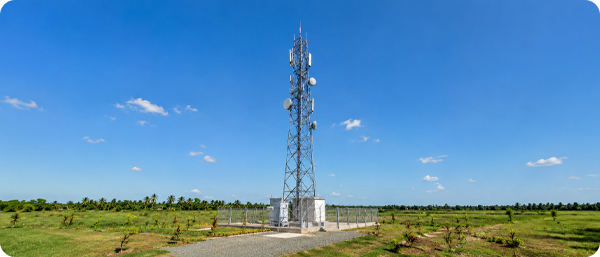
Greenfield Communication Tower (Ground-Based Tower)
Greenfield towers are ground-mounted lattice steel structures designed for open terrain — rural areas, village outskirts, mountain ridges, and industrial sites — where land is available and signal reach is the primary design objective. They provide optimal antenna elevation and sectorization for 4G/5G mobile networks, broadcast relay, point-to-point microwave links, and multi-operator base station sharing.
Structural characteristics:
Angle steel lattice or steel tube lattice construction
Flexible height: 15m to 60m, or customized to project requirement
Foundation: concrete isolated pad or drilled pile foundation to match soil bearing capacity
Strong multi-load bearing capacity: simultaneous mounting of multiple antennas, RRUs, feeder cables, and maintenance platforms
Hot-dip galvanized to ≥90μm per ISO 1461; 30-year anti-corrosion warranty; applicable for coastal (C5-M) and industrial (C4) environments
Wind-load rated: designed to local ASCE 7 / TIA-222 / EN 1991-1-4 or national standard wind speed zones
Key advantages:
Wide coverage radius — unobstructed signal propagation at elevation
Scalable design: future antenna additions and load upgrades accommodated in initial structural design
50-year structural design life — long service life reduces tower replacement frequency
Suitable for high-load, multi-operator shared base stations: reduces per-operator infrastructure cost
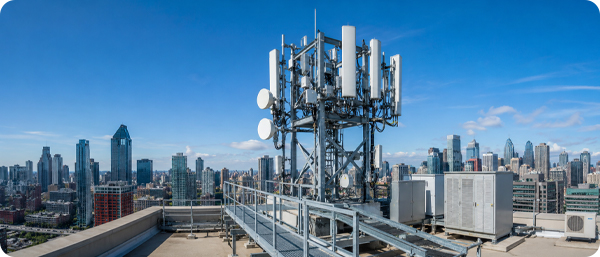
Rooftop Communication Tower (Roof-Mounted Tower)
Rooftop towers are designed for urban environments where land acquisition is impractical or prohibited and rooftop real estate is the available deployment option. They extend antenna elevation above the building parapet in CBDs, residential zones, and industrial building rooftops where building height already provides partial coverage.
Structural characteristics:
Roof-mounted pole, roof truss frame, or parapet wall extension bracket
Height: 3m to 15m, minimizing visual impact on building exterior
Mounted on existing building roofs and parapet walls — no land acquisition required
Lightweight design: minimizes additional structural load on existing building slab
Fast installation: 1–2 day site erection without heavy lifting equipment
Finish options: hot-dip galvanized or epoxy paint + polyurethane topcoat for architectural coordination
Key advantages:
No land acquisition, low construction cost, fast deployment
Ideal for urban vertical densification — filling coverage gaps in high-rise zones
Flexible configuration: adapts to varied roof structures and parapet geometries
Architecturally discreet: slim-profile design coordinates with building